Emergency Contraception Options: A Comprehensive Guide
Let’s be honest — life doesn’t always go according to plan. Maybe the condom broke, you forgot to take your daily pill, or things just happened in the heat of the moment without protection. First, take a deep breath and don’t panic. It happens to the best of us.
That is exactly why Emergency Contraception (EC) exists. It is a backup plan to help prevent pregnancy after unprotected sex, giving you a second chance to stay in control of your reproductive choices.
What is Emergency Contraception?
Emergency contraception, often called the “morning-after pill,” is a safe way to prevent pregnancy after unprotected sex. It works mainly by delaying ovulation so sperm cannot meet an egg. It is NOT an abortion pill — it prevents pregnancy before it begins.
The Main Options
There are three highly effective types of emergency contraception:
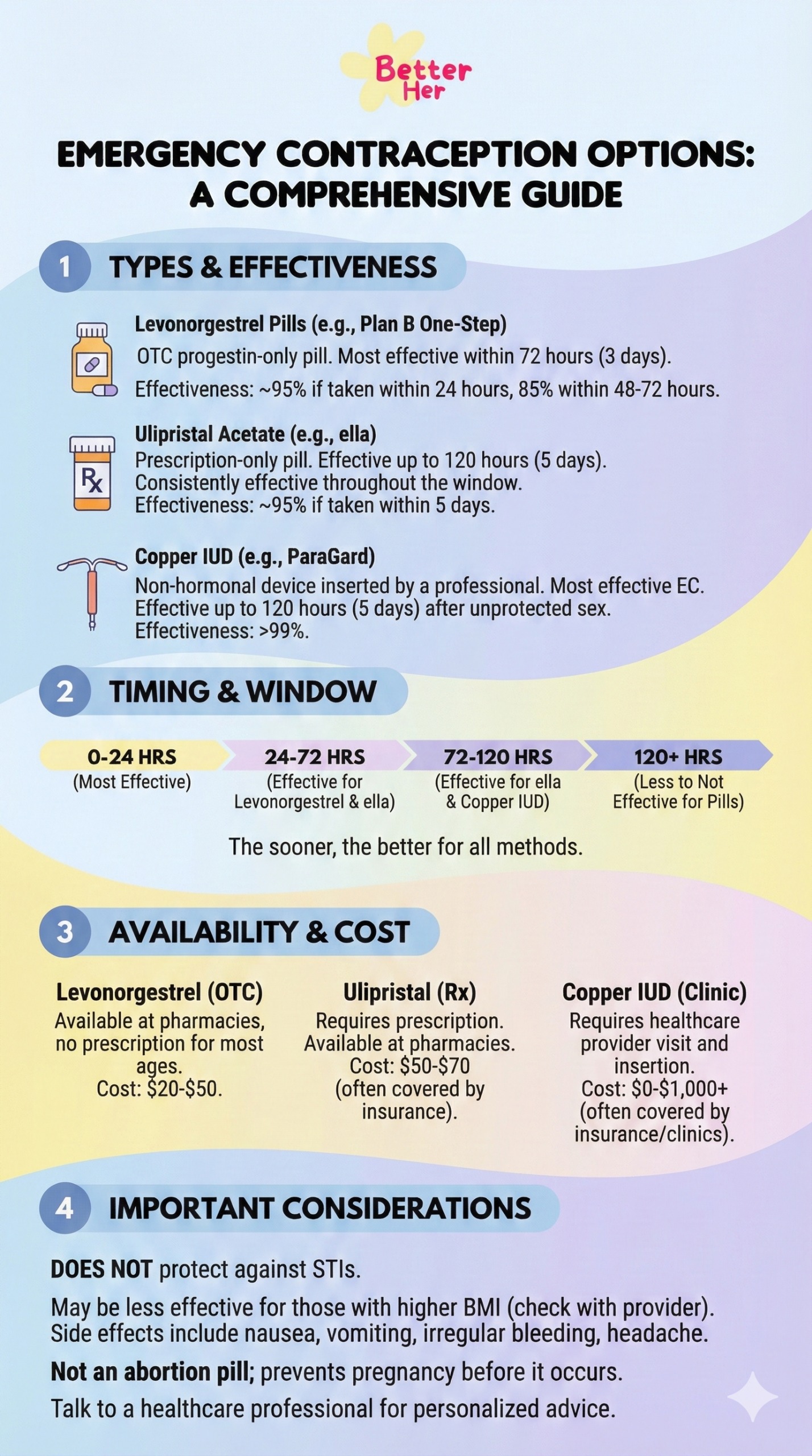
Comprehensive overview of types, timing, effectiveness, availability, and important considerations
Detailed Breakdown from Your Guide
1. Levonorgestrel Pills (e.g., Plan B One-Step, Postinor-2)
The most common “morning-after pill.” Available over-the-counter at pharmacies. Works best within 72 hours (3 days), with highest effectiveness in the first 24 hours. Affordable and easy to access.
2. Ulipristal Acetate (ella)
A stronger prescription pill that remains effective up to 120 hours (5 days). Often better for later use or higher BMI.
3. Copper IUD (e.g., ParaGard)
The most effective option (>99%). Inserted by a healthcare provider within 5 days. Provides long-term contraception (up to 10–12 years) after serving as EC.
Important Facts to Remember
Key Points
- The sooner you act, the better — all methods work best as soon as possible.
- EC does NOT protect against STIs — use condoms for that.
- It is NOT an abortion pill — it prevents pregnancy before it starts.
- EC is for emergencies only — not meant as regular birth control.
- Common side effects: nausea, headache, irregular bleeding, fatigue — usually mild and temporary.
What to Expect After Taking EC
You might feel a little nauseous, have a headache, or notice your next period comes early or late. This is normal. Your cycle may be irregular for a month or two.
You have the right to judgment-free care. Speak to a pharmacist or visit a clinic if you have questions.
← Back to Blog